Our site archives all of Donald Trump's TRUTH Social posts, providing a searchable index of his statements, video transcripts, and image descriptions.
Menu
Our site archives all of Donald Trump's TRUTH Social posts, providing a searchable index of his statements, video transcripts, and image descriptions.

Truth Details

Alexander Talel, CNN: “To ignore the injustice of the law as applied to Trump is to welcome its unfair application to us all...The commercial consequences of the law are disturbingly obvious and potentially devastating. If an individual puts two properties up for sale at double the value assessed by a third-party appraiser, could the AG go after that seller for repeated ‘fraud’ under the Executive Law, despite buyers happily paying the asking prices? Apparently. What about a deli owner claiming in ads to have the ‘best sandwiches in the world’? Could the AG go after that owner for ‘fraud’ even though customers have only praised and never complained about the quality of those sandwiches?”
  Information

Original Post Date
Capture Date
TRUTH Social status ID 111624549803189307
Original URL https://truthsocial.com/@realDonaldTrump/111624549803189307

  File Attachments

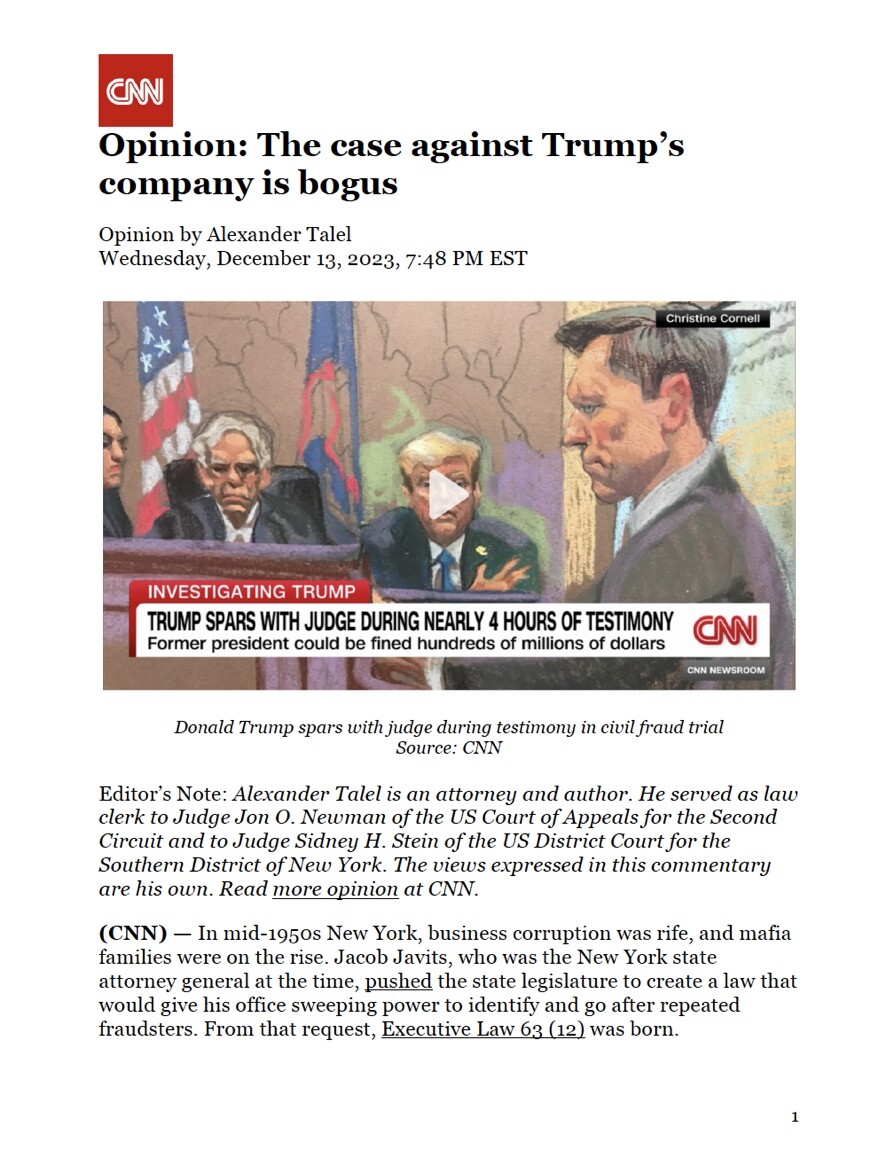
Image Description:
CNN logo, article title reads "Opinion: The case against Trump’s company is bogus," by Alexander Talel, December 13, 2023, 7:48 PM EST. Below the headline is an illustration of a courtroom scene labelled "Donald Trump spars with judge during nearly 4 hours of testimony." The article's subtext reads "Former president could be fined hundreds of millions of dollars." An editor's note clarifies the author's credentials and indicates his opinions are his own. Below the image follows a brief history of business corruption in mid-1950s New York, referencing Executive Law 63 (12).
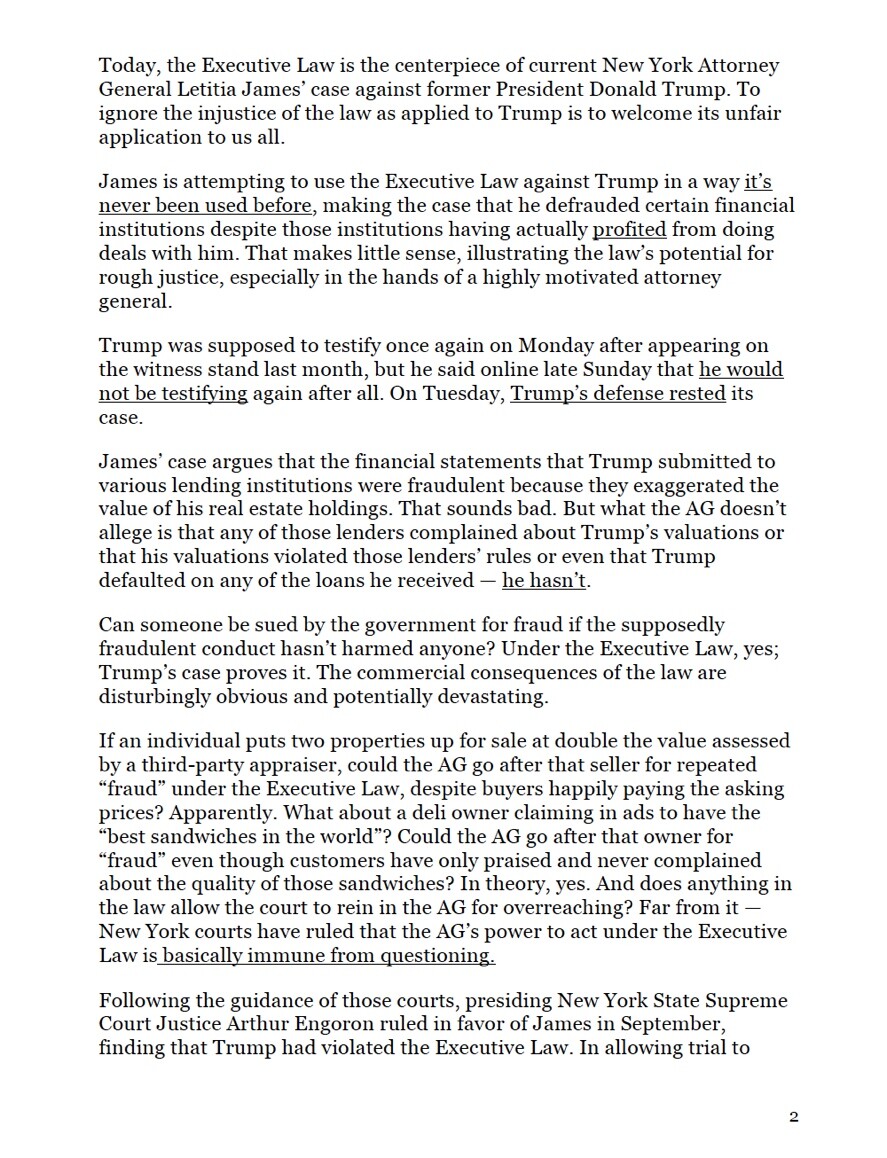
Image Description:
A legal document or article discussing New York Attorney General Letitia James' case against former President Donald Trump. The text critiques the application of the Executive Law and its unprecedented use in the case, questioning the rationale and consequences. It mentions Trump's refusal to testify and the conclusion of his defense. The discussion includes the implications of financial statement allegations and how New York courts have supported the AG's power under the law. The presiding New York State Supreme Court Justice Arthur Engoron is highlighted for ruling in favor of James. Comparing hypothetical scenarios of "fraud," it calls into question the fairness and potential overreach of the Executive Law.
Image Description:
Proceed on the issue of damages, Engoron also ruled that disgorgement — the remedy sought by the attorney general, which compels an individual to return illegally made profits — is “equitable in nature, mandating that the trial be a bench trial, one that a judge alone decides.” That ruling makes clear how the Executive Law allows a court to deny an accused individual their constitutional right to a jury trial. Equitable disgorgement usually involves ill-gotten profits — in an insurance scam, for example, in which an individual tricks another into paying premiums for a non-existent policy, disgorgement would require the scammer to pay back whatever profits they illegally collected from the victim. That kind of straightforward calculation might be appropriate for a judge to decide alone. But there are no victims in Trump’s case and, therefore, no ill-gotten profits. So when James asks that an “estimated” $250 million be disgorged from Trump, what she’s really seeking is a massive penalty — not a specified, equitable remedy pegged to a victim’s suffering, but the kind of unspecified and punitive money damages typically left for juries to decide. Instead of a jury, however, Trump gets Engoron, who isn’t sympathetic to the free-market economic principles underlying his defense. In his September ruling, Engoron ridiculed Trump for “essentially arg[uing] that value is inherently subjective.” But value is often subjective, particularly in the real estate market. Engoron’s decision