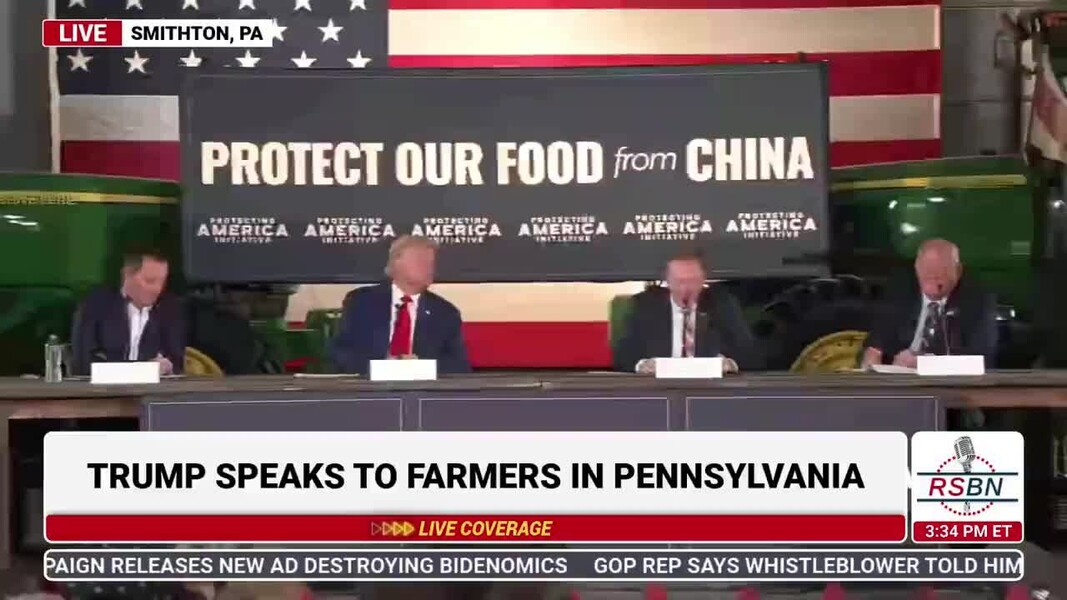
Beth Leeper is a small business owner former dairy farmer and current beef and crops farmer from Westmoreland County like to introduce Beth Leeper
Mr. President government and elected officials and honored guests Thank you for coming to Western PA again today to hear our concerns and address solutions.
My name is Beth Lieber, and to play opposite of Nick, I married the farmer's son,
who is here today with my 2 sons, Levi and Owen.
I'm a Christian,
a wife, a mother of 3, and a small business owner in that particular order.
I, with my husband Brian,
own and operate a direct to consumer on the farm market featuring beef that has been raised on the family farm in Donogall, PA.
We procure lamb, chicken, and pork from other small farms in Pennsylvania like ours, and all the animals are harvested
through local processors to our specifications.
Since opening in 2017,
our goal has been to provide our customers with consistently high-quality products while also supporting other small businesses and our community.
In May of 2020, we expanded our store and offerings due to the needs of consumers during COVID and to offer other businesses
another avenue
to sell their goods.
We now offer several agricultural
and specialty items all produced in or near the Laurel Highlands area.
My husband is also a full-time owner operator of transport in the dry bulk industry, and I also work part-time for a Christian school as the food service director.
I share our occupations as an introduction to explain the challenges
due in large part to the inflation that we have seen, that we have witnessed and experienced
both as a producer and a retailer and also a consumer.
As a truck driver, my husband normally fills his truck 2 to 3 times a week with diesel.
In January of 21, just after Biden revoked the Keystone pipeline,
1 of our fuel receipts totaled $592
for 200 gallons of fuel. That was $2.99
a gallon.
In May of 22,
a year after our energy independence
moved overseas,
1 of our fuel receipts totaled $996
for
166 gallons of fuel. That was $5.99
a gallon.
That $3 per gallon more means upwards of $800 to $1, 200 a week
in fuel expense and less to meet our business and families' needs.
This net 0 approach has also increased farm costs exponentially,
which I know comes as no surprise to anyone here today.
Fertilizer is up 30 to 60 percent in 2024,
not to mention the increase in seed
costs, the fuel, the parts and supplies, and man hours for planting.
Electric has doubled from around $400 a month in 2021
to $800
a month this year, just to run some equipment and the lights that doesn't include heat.
In 2023,
feeder calf prices reached an all-time high, coupled with the increase in other commodities and prices to farmers not keeping up, this equals very small profit margins and therefore
we have been purchasing a fraction of the feeder cattle that we have the capacity to feed. Our farm currently feeds out approximately
70 to 100 head of cattle, and that is reduced from 180 to 200 head just 2 to 4 years ago.
But we have the capacity to feed upwards of 400 to 500.
Actually we are currently feeding only enough to satisfy our direct-to-consumer
base, as it remains somewhat constant. The seasonal tourism of camping and skiing in the Laurel Highlands contributes to our sales,
and we are located in the heart of the Laurel Highlands.
I handle all of the customer relations for our on the farm market and our customers often share their concerns with me. These are some of the things I hear most often.
I really don't eat a lot of beef anymore. It costs too much.
I can't afford to purchase a whole animal this year. What smaller packages do you offer?
We are visiting from out of town. We don't have any places like this where we are from.
And recently,
the thing I've heard the most
is I used to purchase bulk beef from a farmer nearby,
a friend, a relative,
but they don't have cattle anymore.
Just last week, a local dairy in operation for over 65 years announced the closure of their bottling operations due to rising costs of supplies and down demand.
Other farms in the area have declared bankruptcy or sold off property and downsized.
I can't even get started on the detrimental effects that the weather has had on the vegetation in our region this year. From hail storms to droughts, our corn and soybeans were among the victims.
Nevertheless,
farmers are no strangers to the risk and the gamble that they take every single day in order to do what they know and love, and that is to farm their land.
And as always, this too shall pass,
hopefully soon.
Jeremiah 29, 11 tells us, for I know the plans I have for you, plans to prosper you and not harm you, plans to give you hope and a future.
I'm not an economist, and to be honest, foreign policy is not in my wheelhouse.
But this roundtable event is to address
on how to protect our farms and food from China.
It seems like basic, conservative,
common sense to me. Do what it takes to keep our farms producing,
our markets selling, and our customers
buying. Thank you for your time. Thank you.